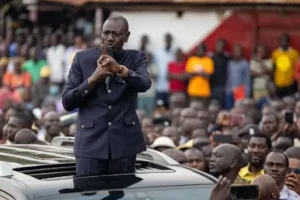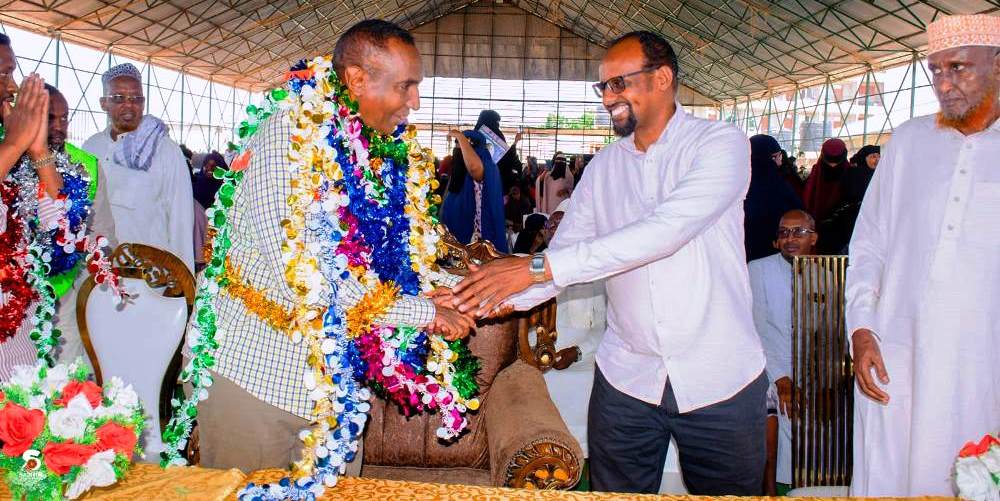


Prime Cabinet Secretary Musalia Mudavadi and National Assembly Speaker Moses Wetangula with former President Uhuru Kenyatta at the burial of Cyrus Jirongo in Lumakanda. PHOTO|UGC
By PATRICK MAYOYO
The political arena of western region; comprising Kakamega, Vihiga, Busia, Bungoma and Trans Nzoia counties, appears to be on the cusp of a profound political re-alignment ahead of the 2027 polls.
Long regarded as politically divided yet numerically significant, the region has historically struggled to translate its demographic strength into sustained national influence.
Recent developments, however, suggest that the established order dominated by Prime Cabinet Secretary Musalia Mudavadi, National Assembly Speaker Moses Wetang’ula and Cabinet Secretary Wycliffe Oparanya may be facing an existential challenge from a new generation of political actors.
The funeral of former Cabinet minister and Lugari MP Cyrus Jirongo has emerged as a symbolic moment, exposing shifting loyalties and signalling the possible rise of new Luhya political luminaries ahead of the 2027 general election and beyond.
Jirongo’s controversial death that occurred on the morning of 13 December 2025, following an alleged head-on collision between his car and a bus has raised a storm with a cross-section of leaders claiming foul play and demanding for private investigations to unearth the truth.
To fully appreciate the significance of the changing political dynamics in among the Luhya, it is essential to situate them within the broader historical trajectory of Luhya politics since independence. The Luhya community, Kenya’s second largest ethnic bloc, has produced numerous national leaders but has rarely spoken with one political voice.
It has to be also remembered that the community has produced three Vice President since independence that includes Mudavadi, the late Ford Kenya leader Kijana Wamalwa and Moody Awori. Mudavadi also contested for the presidency in the 2013 general election on the United Democratic Forum Party where he finished third.
At independence, the Luhya community’s political elite were divided between the Kenya African National Union (KANU) and the Kenya African Democratic Union (KADU).
Mombasa Governor Abdulswamad Shariff and other leaders pay last respects to Jirongo’s body before his burial. PHOTO/UGC
While Masinde Muliro emerged as a towering intellectual and nationalist figure, his federalist leanings and opposition to Jomo Kenyatta’s centralised state ultimately consigned Luhya politics to the margins of power during the early post-independence period.
The death of Muliro in 1992 created a vacuum that successive leaders attempted, but failed, to fill as Luhya supremacy wars revolved around then Cabinet Ministers Moses Mudavadi, Burudi Nabwera, Elijah Mwangale and marverick Butere MP Martin Shikuku, until during the re-introduction of multiparty politics in the 1990s, when politicians like Michael Kijana Wamalwa, Wycliffe Oparanya, Musalia Mudavadi and Moses Wetang’ula rose to prominence, often in competition with one another.
Wamalwa’s brief tenure as Vice-President following the National Rainbow Coalition (NARC) victory in 2002 briefly raised hopes that the community had finally secured a foothold at the centre of power. His death in 2003, however, once again disrupted efforts to consolidate Luhya political influence.
The 2002 general election remains a defining reference point for current political realignments in western Kenya. In the twilight of his rule, President Daniel arap Moi appointed Mudavadi Vice-President and later endorsed Uhuru Kenyatta as his preferred successor, with Mudavadi as his running mate.
In contrast, Kijana Wamalwa allied himself with Mwai Kibaki and the opposition coalition. The decisive defeat of Moi’s chosen successor underscored a recurring lesson in Kenyan politics: proximity to the state does not automatically translate into popular legitimacy.
For Mudavadi, the episode marked the beginning of a long and uneven political journey characterised by shifting alliances and unmet expectations.
In the years that followed, the late ODM leader Raila Odinga repeatedly attempted to elevate Mudavadi as a national figure through the Coalition for Reforms and Democracy (CORD) and later the National Super Alliance (NASA).
Despite these efforts, Mudavadi struggled to command unquestioned loyalty within the Luhya electorate. His eventual decision to join President William Ruto’s Kenya Kwanza Alliance ahead of the 2022 elections secured him the current controversial Prime Cabinet Secretary that is not anchored in law, but it also reinforced perceptions among some voters that he was more adept at elite bargaining than grassroots mobilisation.

ODM Secretary General Edwin Sifuna speaking at the burial of Cyrus Jirongo in Lumakanda. PHOTO/UGC.
A similar critique has increasingly been directed at Wetang’ula and Oparanya. Wetang’ula, a seasoned political operator and long-time leader of Ford Kenya, has maintained relevance through strategic alliances, culminating in his election as Speaker of the National Assembly.
Oparanya, a former Kakamega governor and now Cabinet Secretary, is widely regarded as a competent administrator. Yet both men, like Mudavadi, are seen by a growing segment of the electorate as representatives of an older political order that has failed to decisively uplift the region or articulate a compelling future vision.
It is against this backdrop that the burial of Jirongo took on political significance beyond the solemnity of the occasion. Funerals in western Kenya have long served as arenas for political expression, and Jirongo’s burial was no exception.
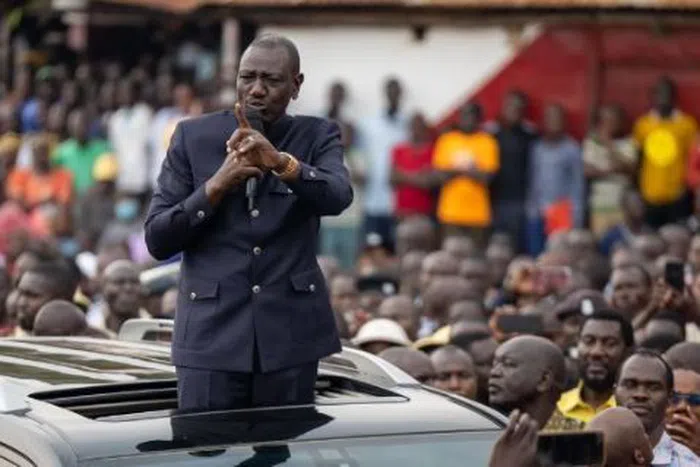
The reactions of mourners to various leaders’ speeches provided a rare, unfiltered glimpse into popular sentiment. While Mudavadi, Wetang’ula, Kakamega Governor Ferdinand Barasa and Busia Governor Paul Otuoma received muted or hostile receptions, younger or more outspoken figures such as ODM Secretary General Edwin Sifuna, Vihiga Senator Godfrey Osotsi, former Vihiga Senator George Khaniri, Kakamega Senator Bonny Khalwale and even the mention of Trans Nzoia Governor George Natembeya elicited enthusiastic applause.
These reactions were not merely about personalities; they reflected deeper frustrations with perceived political complacency and transactional leadership.
Sifuna’s bold declaration that he was prepared to contest the presidency in 2027, should Mudavadi and Wetang’ula defer their ambitions to 2032, resonated strongly with mourners.
His remarks contrasted sharply with the public commitment by Mudavadi and Wetang’ula to support President Ruto’s re-election bid, a stance that many in the region view as offering little immediate political dividend for western Kenya.
The applause for figures such as Sifuna, Osotsi, Khaniri and Dr Khalwale points to a desire for leaders who are seen as assertive, independent-minded and willing to confront national power rather than merely negotiate accommodation within it.

Kanu party leader Gideon Moi and Kakamega Governor Ferdinard Baraza at Jirongo’s burial ceremony. PHOTO/UGC.
Dr Khalwale, in particular, has cultivated an image of fearless advocacy, while Osotsi has positioned himself as a bridge between generational cohorts. Khaniri’s re-emergence underscores the enduring appeal of leaders who are perceived as principled and community-rooted, even after electoral setbacks.
Trans Nzoia’s Governor Natembeya represents another intriguing dimension of this evolving scenario. Though geographically and ethnically more diverse, Trans Nzoia has increasingly been folded into the broader conception of the “Mulembe Nation”.
Natembeya’s popularity suggests that future Luhya leadership may emerge not only from traditional strongholds such as Kakamega and Bungoma but also from frontier counties that symbolise dynamism and demographic change.
Looking ahead to 2027, the implications for President Ruto’s Kenya Kwanza Alliance are significant. The assumption that Mudavadi and Wetang’ula can effortlessly deliver western Kenya votes in exchange for high-ranking state positions is increasingly questionable.
The region’s electorate, particularly younger voters, appears more sceptical of elite pacts and more receptive to leaders who articulate a confrontational or reformist agenda. Convincing voters in Kakamega, Vihiga, Busia, Bungoma and Trans Nzoia to rally behind Ruto may therefore prove to be a herculean task.
Nevertheless, it would be premature to write off Mudavadi, Wetang’ula and Oparanya entirely. Their experience, institutional access and ability to influence resource allocation remain potent assets. Moreover, Kenyan politics is fluid, and alliances can shift rapidly in response to national crises or electoral calculations.
The challenge they face is not merely one of age or tenure, but of narrative: whether they can convincingly reposition themselves as agents of transformation rather than custodians of the status quo.
The emerging political re-alignments within the Mulembe Nation suggest that Luhya politics is entering a critical phase of introspection and renewal. The Jirongo funeral served as a dramatic illustration of changing popular moods and generational aspirations.
Whether politicians such as Sifuna, Osotsi, Khaniri, Dr Khalwale and Governor Natembeya can coalesce into a coherent leadership bloc remains to be seen.
What is clear, however, is that the era in which a handful of senior leaders could claim unquestioned authority over western Kenya is drawing to a close.
As 2027 approaches, the region stands at a crossroads, with the potential either to repeat its historical patterns of divisions or to finally forge a new political order capable of reshaping its place in Kenya’s national story.