

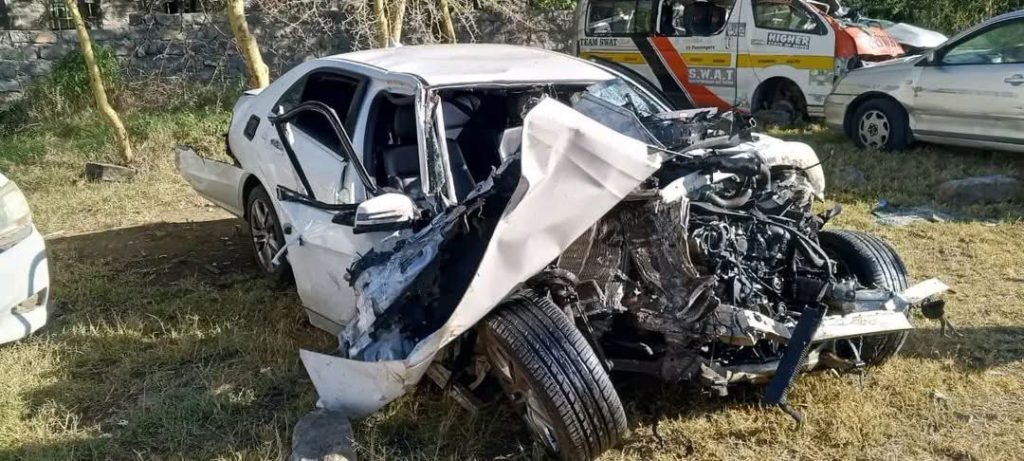
The mangled wreckage of Jirongo’s Mercedes-Benz E350. PHOTO/UGC.
By EW Team
newshub@eyewitness.africa
A postmortem conducted on the body of former minister and legislator Cyrus Jirongo has revealed that he died from blunt force trauma, but mystery continues to surround the circumstances of his death.
In medical terms, blunt force trauma refers to physical injury caused by impact with a non-penetrating object or surface. The force is applied without breaking the skin in the way a knife or bullet would, but it can still cause severe or fatal internal injuries.
Blunt force trauma occurs when the body is struck by, thrown against, or crushed by something solid. The skin may remain intact, or there may be bruises and abrasions, but the damage often occurs beneath the surface.
Jirongo, known for leading the Youth for KANU ’92 movement in the 1990s, died on 13 December 2025 in what police initially described as a head-on collision on the Nairobi–Nakuru highway near Naivasha. The 64-year-old businessman was driving his Mercedes-Benz E350 (KCZ 305U) when it collided with a Climax Coaches bus (KCU 576A) carrying 65 passengers to Busia, according to a police statement.
A team of pathologists led by Dr Johansen Oduor said there were multiple severe injuries resulting from fractures sustained during the fatal incident. The group, which included three family doctors, said the impact was so severe that it caused Jirongo’s instant death. They revealed that the legs, ribs and spine were affected, with extensive bleeding into the abdominal and chest cavities.
Related story
Cyrus Jirongo: Maverick politician and deal-maker
https://www.eyewitness.africa/cyrus-jirongo-maverick-politician-and-business-gambler/
However, forensic discrepancies, a puzzling timeline and Jirongo’s recent business dealings have fuelled calls for deeper scrutiny from his family, allies and independent experts.
As forensic teams revisit the scene, the four-hour window from Karen demands phone records, additional CCTV footage and passenger accounts. Kenya’s history of opaque investigations into high-profile deaths heightens the stakes: transparency could dispel conspiracy theories or expose serious flaws. Without it, doubts persist.
The Directorate of Criminal Investigations (DCI) has vowed to trace Jirongo’s prior movements, including recording statements from those at the Karen bar, and to submit a file to the Director of Public Prosecutions.

The Climax Coaches bus. PHOTO/UGC.
The DCI states that footage from Eagol Petrol Station captures Jirongo’s final moments: arriving from Nairobi at 2:18:40 a.m. without refuelling, pausing at the exit at 2:19:10 a.m., turning right towards Nairobi at 2:19:19 a.m., and colliding with the bus six seconds later. The impact reportedly hurled his vehicle 25 metres, while the bus stopped 50 metres away; Jirongo suffered fatal head injuries.
Independent forensic analysis presents a different account. Experts point to primary damage on the rear-left quarter and wheel area, including an inward-shattered tail lamp and distortion, consistent with a strike from a “faster, heavier vehicle” while Jirongo’s car was slowing or decelerating. Frontal damage, including asymmetrical engine block collapse, appears secondary and catastrophic, rather than indicative of a self-initiated head-on collision.
Investigators are expected to retrieve data from the Mercedes’ Safety Restraint System (SRS) or Electronic Control Unit (ECU), which record speed, impacts and airbag deployment, despite advanced Pre-Safe features that should have activated protective measures. Airbags reportedly failed to deploy, an anomaly in severe frontal collisions.
Jirongo had left Karen Oasis Bar, owned by Rebmann Malala, after 11 p.m. following a meeting with National Assembly Speaker Moses Wetang’ula and others, and was reportedly heading to his Gigiri home in Nairobi, about 20 kilometres away. The 80-kilometre detour to Naivasha has baffled associates.
Bus driver Tyrus Kamau Githinji, released on bail for dangerous driving and due back in court on 22 December, claims Jirongo veered into his lane amid traffic. Yet no passenger manifest has been released, nor statements from the 65 passengers, despite assurances of follow-up.
Petrol station staff were interviewed, but wider witnesses remain elusive. Lawyer Kibe Mungai described the lack of bystanders at the scene as “highly unusual”. The timeline for the replacement bus to Busia and the bus registration details remain undisclosed.
Philip Kisia, former Nairobi Town Clerk, said Jirongo’s recent minerals trade from the Democratic Republic of Congo had made him “a threat to some people”. He had planned to have lunch with Jirongo the following day alongside former Vihiga Senator George Khaniri.
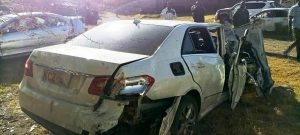
Rear view of Jirongo’s Mercedes-Benz E350. PHOTO/UGC.
Speculation about carjacking or a staged incident continues online, amplified by re-circulated old videos of Jirongo socialising amid claims of crushed limbs.
Former Westlands MP Fred Gumo, who is co-chairing Jirongo’s funeral committee with Khaniri, has publicly questioned the Naivasha journey. “The inconsistencies suggest a cover-up, or at the very least, gross incompetence,” Gumo said. “We need answers, not just for the family, but for the people of Kenya.”
Opposition leaders, including presidential aspirant Kalonzo Musyoka, DCP leader Rigathi Gachagua, DAP-K leader Eugene Wamalwa and DP leader Justin Muturi, have urged government agencies to conduct a thorough, transparent and independent investigation.
“Accountability is not optional. It is essential to public trust and the rule of law. Nothing should be concealed, and nothing should be ignored. No stone should be left unturned,” Kalonzo said.
According to a mechanical engineer, another focus of investigations into Jirongo’s Naivasha crash is the physics behind a collision between a saloon car and a bus in relation to speed and velocity.
The engineer explained that when a saloon car such as a Mercedes-Benz E350 collides with a bus, the physics of the impact helps explain why damage is usually far more severe for the car than for the bus. This involves factors such as speed, momentum, energy and the forces generated during a crash.
He said that in a collision between a saloon car weighing 1,000–1,500 kg and capable of 120 km/h, and a bus weighing 10,000–18,000 kg and typically travelling at 30–50 km/h in urban areas, the bus’s greater mass means it sustains far less damage.
“Newton’s Second Law shows that force depends on mass and acceleration; the lighter car crumples first, absorbing most of the impact in an inelastic collision where momentum is conserved but converted into heat, noise and wreckage,” he said.