


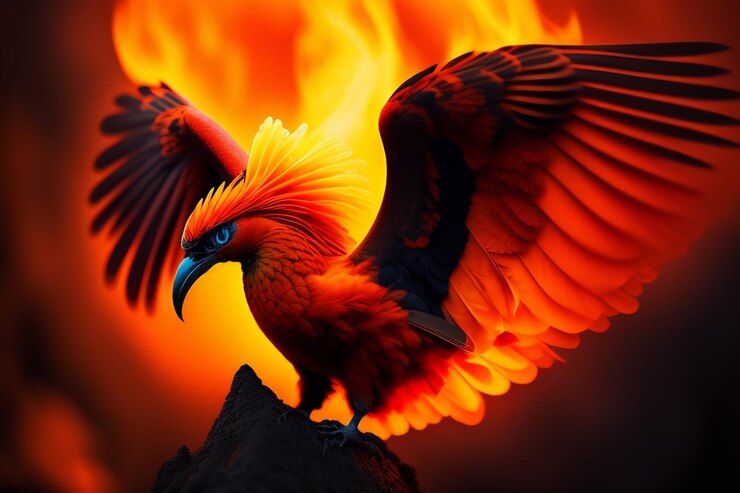
In a world marked by environmental crises, economic challenges, and global uncertainty, the story of the phoenix offers hope. PHOTO/Freepik.
By TIM HOLT
There are few creatures in the world of mythology and folklore that hold such an iconic place in the hearts and minds of humanity as the phoenix.
A symbol of rebirth, immortality, and eternal cycles, this legendary bird has transcended cultures, sparking the imagination of writers, artists, and dreamers for millennia.
The phoenix, often depicted as a majestic bird with radiant feathers in hues of gold and crimson, is said to have originated in ancient Egypt. In Egyptian mythology, it was known as the Bennu, a bird whose name means “to rise” or “to shine,” symbolic of the sun god Ra.
This celestial connection emphasized the phoenix’s association with life, death, and renewal. Over time, the bird’s myth spread to other ancient civilizations, each adapting its story to their own beliefs.
In Greek mythology, the phoenix was described as a bird that lived for 500 years, its brilliant plumage said to shine like the sun. As its life drew to an end, the phoenix would build a nest of aromatic wood, set it on fire, and be consumed by the flames.
Yet, from the ashes, a new phoenix would rise, reborn to begin its cycle once again. The Greeks admired the phoenix for its embodiment of resilience and transformation, a symbol of hope for all those who witnessed the flame of its destruction and rebirth.
Although the phoenix has its roots in Egyptian and Greek mythology, variations of this mythical bird appear throughout many other cultures, each with its own unique take on the bird’s story.
In China, the fenghuang is the counterpart to the phoenix, often called the “Chinese Phoenix.” Though not directly associated with rebirth in the same way, the fenghuang embodies harmony and balance, often representing both the emperor and empress. In this culture, it is a bird of peace and prosperity, deeply entwined with the elements of fire, water, and earth.
Meanwhile, in the Arab world, the phoenix is also known as the Simurgh, a benevolent and wise bird who plays a key role in Sufi literature, symbolizing spiritual growth and enlightenment.
In modern times, the story of the phoenix has been reimagined in countless forms, from literature and cinema to video games and branding. Perhaps most famously, the bird has appeared in J.K. Rowling’s Harry Potter series.
The phoenix is not just a relic of ancient mythology but a timeless symbol of possibility. PHOTO/UGC.
Here Fawkes, Dumbledore’s loyal companion, showcases the phoenix’s magical ability to heal wounds, regenerate, and rise from the ashes, embodying loyalty and sacrifice.
The phoenix also continues to serve as a powerful symbol for personal growth, with people worldwide adopting its image to signify overcoming adversity, personal transformation, and even the triumph of the human spirit in the face of hardship.
Though the phoenix itself may never have existed as a tangible creature, its symbolism is very much alive. The idea of transformation and cyclical renewal resonates deeply within human experience.
From overcoming personal tragedies to collective movements toward social change, the phoenix remains a metaphor for those who, like the mythical bird, emerge stronger and renewed after facing destruction or despair.
In a world marked by environmental crises, economic challenges, and global uncertainty, the story of the phoenix offers hope. Just as the phoenix rises from the ashes of its predecessors, humanity too has the potential to heal, rebuild, and emerge stronger from the ashes of its trials.
The imagery of a bird soaring toward the sun, with wings that stretch beyond the clouds, has become a beacon of optimism. The phoenix is not just a relic of ancient mythology but a timeless symbol of possibility.
It calls to us not to fear the end, but to embrace the new beginning that follows it. Whether it is in the context of a personal journey, a cultural shift, or the collective recovery from difficult times, the phoenix stands as a reminder that life is cyclical—after every sunset, there is the promise of a sunrise.
The legacy of the phoenix, with its stunning imagery of fire, renewal, and the endless possibilities that follow destruction, will undoubtedly continue to inspire generations for years to come.
In a world that’s constantly changing, perhaps the myth of the phoenix is one of the most enduring and beautiful expressions of human resilience, transformation, and the power of new beginnings.