

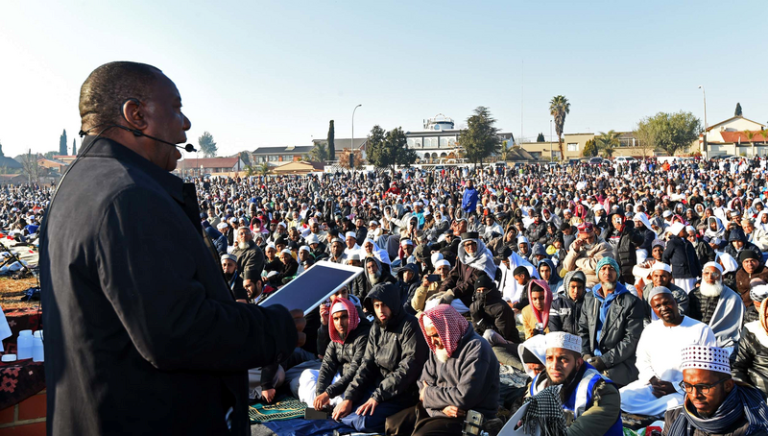
President Cyril Ramaphosa’s ruling African National Congress (ANC) received only 40.18 percent votes in the May 29 election, well short of a majority. PHOTO/Wikimedia Commons.
KEY FACTS
- ANC: 230 seats (57.5 percent)
- DA: 84 seats (21 percent)
- EFF: 44 seats (11 percent)
- Inkatha Freedom Party (IFP): 14 seats (3.5 percent)
- Ten other parties make up the remaining 28 seats.
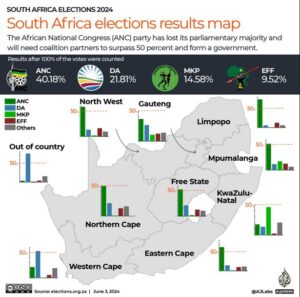
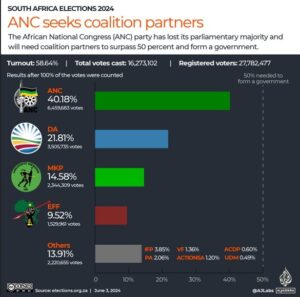
Votes garnered in percentage
- ANC 40.18%
- Democratic Alliance (DA) 21.81%
- MK party 14.58%
- EFF 9.52%
Data/Aljazeera
By MORRIS ODHIAMBO
The general elections in South Africa, which took place on 29 May 2024, happened when I was reviewing one of the most inspiring books I have ever read. The book, titled “We the People: Thinking Heavenly, Acting Kenyanly”, is the official memoir of Reverend Dr. Timothy Njoya, a Kenyan cleric, scholar and social rights activist.
I first met Dr. Njoya when I was a young activist associated with the Centre for Law and Research International (CLARION), the organisation I led for some 8 years as the Chief Executive Officer.
I became the representative of CLARION at the National Convention Executive Council (NCEC) when Reverend Njoya was the chairman. NCEC was the secretariat of a larger movement for constitutional change, the National Convention Assembly.
The reason I was re-reading Njoya’s book was to get inspiration after I had gone through a torturous experience at the hands of colleagues in the civil society “sector” with whom I worked for six months, from November 2023 to April 2024.
During this time, I was the coordinator of the Missing Voices Coalition (MVC), which advocates against extrajudicial killings and enforced disappearances in Kenya (this will form another chapter in my reflections on the challenges of leadership in Kenya’s civil society movement).
I felt the need to reflect, recharge and reorient myself to the real challenges facing the state in Africa (and Kenya) so as to shift the locus of turbulence and conflict from within myself. Dr. Njoya’s book provides exactly the kind of inspiration I required.
INFOGRAPHIC/SCREENSHOT/ALJAZEERA
But, pray, what does Dr. Njoya’s book, and his theory of transformation, have to do with the South African elections and its outcomes? This is what my reflections today are all about.
First, in his memoir, Dr. Njoya rejects the common trend of telling a “success” story. By this, he means the situation in which many personalities in Kenya (and elsewhere) tell stories of how they acquired material success.
Some of these “simple” stories of success with titles like “From Grass to Grace”, are used to camouflage the real social and economic conditions underlying individual success in a corruption-ridden, post-colonial situation.
The individuals telling these stories make an attempt to de-link their success from the fact that they are largely former government bureaucrats whose wealth cannot be explained outside the framework of corruption and primitive accumulation. Even where the individuals in question are known thieves of public property and engineers of corruption scandals, they use their stories to hide their malfeasance.
But Njoya equally rejects the same trend among the people he fought with for Kenya’s so-called “second liberation”. For him, to the extent that Kenya’s “second liberation” did not make the citizens sovereign, it was all an illusion.
He attributes the “second liberation” myth to the lack of a theory of transformation among its chief proponents. Transformation, for him, can only happen once the citizen has been transformed from a product of the market to a sovereign being.
Simple yet complex, Njoya’s theory says that Kenyans were turned into commodities when the country became Britain’s overseas market through the Imperial British East Africa Company (IBEACo). This marketisation was a continuation of the condition of the African as a slave in a different epoch.
Independence did not materially change this situation. It only introduced new stewards of the market in the name of the African elite to hold fort for the British and continue exploitation of the African person for the benefit of the market.
Colonial and post-colonial education, according to Njoya, did not make a significant change to the psyche of the African in his/her state as a commodity in the market. In one of the most critical passages in the book, he states as follows:
“Education conditioned African elites to salivate when they see property, making them corrupt as a matter of reflex… Once Kenyans pass exams, they start to believe that nobody creates jobs and money; jobs and money simply exist in nature, and all you need is to sit down in the office and consume them. A system which says “if you think this way you will get this job. Cram this, vomit it back on the exam paper, and you will get a certificate” cannot produce a productive person, only a job-seeker in the market.”
INFOGRAPHIC/SCREENSHOT/ALJAZEERA
In another passage, he links this interpretation of the education system in Kenya to former president Moi’s dictatorship by pointing out as follows:
“The Kenyan system of education, as much as colonialism and slavery, was to blame for producing swimmers with the current. Moi could not single-handedly imagine building the Nyayo House torture chambers without the assistance of his state engineers, architects, lawyers, surveyors and city planners. Without political scientists and sociologists from the best schools in Kenya, Moi’s dictatorship could not have survived…”
One can fault Njoya’s account based on two reasons: his persistent claim that he solely responsible for the attainment of a new constitutional order in Kenya, and, with it, complete lack of appreciation of the roles played by other people. However, this is not the purpose of my reflection today. I will now apply Njoya’s perspectives to the South African situation.
Most analysts of the South African elections have based their views on the “market” and its reaction to the outcome of the election. What is good and beneficial to the market, it is assumed, is also good for the nation and the people.
The position of the voter seems to be only important to the extent that he/she provides legitimacy for profit-making. This situation prompted me to question, in one of my videos last week, “who speaks for the poor in this election?”

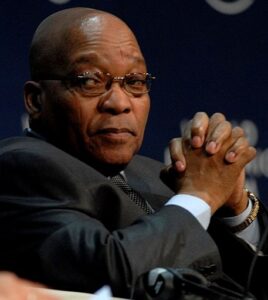
EFF party led by political firebrand Julius Malema got 9.52 percent votes. PHOTO/Wikimedia Commons.
That the ANC has failed South Africans is not in doubt and is reflected in the electoral outcome. The party has been losing support consistently. The main irony is that the failure to meet the expectations of “ordinary” South Africans, is at the same time associated with the very same embrace of market policies that is used as a basis for judging the election. In this sense, ANC is both the main player in this drama as well as its main victim.
In terms of the coalition building that is already unfolding, the imperatives of the market are, again, the primary consideration. The questions being posed are: (a) how will the market react to an ANC coalition with the Democratic Alliance? (b) how will the market react to an alliance between Jacob Zuma’s MK, ANC and Julius Malema’s EFF?
There is no interrogation of whether this market is good for South Africans in their construction of the South African nation. There is no question as to why this market, which is at the same time being blamed for ANC’s failures, will improve the lives of South Africans!
There is no interrogation of how the political economy will be shaped differently to favour nation-building and engineering of peaceful conditions based on justice and dignity for the majority.
If ANC’s failure is largely attributed to the embrace of market principles at the detriment of promoting the general welfare of South Africans, then how will a coalition, most likely pursuing the same policies, solve the problems of inequality, hopelessness, crime and violence facing the country?
The other face of South Africa (the so-called xenophobia) has been forgotten in this rush to justify the demands of the market. The fact that xenophobia has upended the social realities in South Africa, as well as that country’s relations with other African countries, is not a factor in consideration for now.
Xenophobia will be a factor and priority once the haggling for power and sustenance of market imperatives has come to an end through some form of a coalition based on the dictates of global neo-liberal market fundamentalism.
It is at this point that analysts and policy makers alike will turn round and try to figure out why poor South Africans are being “xenophobic” while the market is thriving!
Who will transform South Africa from a market to a society and nation? Where are the social forces that consider this an imperative away from the constant haggling for power and material success among the few at the expense of the majority?
Will the 29 May election, ultimately, make any difference? If not, what is the future of South Africa? What do those who profess Pan Africanism think of this situation?