

Busia Senator and human rights activist Okiya Omtatah leaves the Milimani law court after filling a case. PHOTO/UGC.
By MORRIS ODHIAMBO
Was the attack on the residence of Senator Okiya Omtatah in his county of Busia inevitable? Put another way, could we, scholars and members of the activist and human rights community, have predicted, anticipated, envisaged or expected the attack, assuming, of course, that it is related to his social rights activism? Were there any warning signs that we should have picked up?
Is Senator Omtatah a marked man, and if so, by whom, and for what? As Kenyans like to say, whose goat has the Senator, who is also a prominent activist, eaten?
Sometime back in early 2008, during Kenya’s most significant political rupture in which more than 1,300 people were killed mostly by police, a group of activists sat down to plan an action that would leave an indelible mark on the psyche of Kenyans.
It was an interesting time. One of the things that has stuck in my mind from that time is the refusal by a waiter (a young lady from Central Kenya, judging by the way she spoke Kiswahili) at a bar in Nairobi’s Central Business District (CBD) to serve me, after I revealed to her that I was a member of the Luo community! She had talked disparagingly of the community as “Kenya’s number one problem”, hence my need to conduct a civic education session to correct her!
The idea of tying up one of us outside Vigilance House (on the fence or entrance to the police headquarters), with a heavy duty steel chain, as a mark of protest against the then ongoing killing of innocent Kenyans by police, was the best idea to come out of the discussion when we met that day. After the discussion, Omtatah volunteered to be the one to be tied up.
Having come up with the suggestion in the first place, I surmised that he had already thought through the action and its possible implications and was, therefore, psychologically prepared. It was, therefore, not surprising when he volunteered to be the “sacrificial lamb”.
So we planned the action even as we discussed the message that would be passed on to Kenyans and the local and international press, and the logistics that would go into the “operation”.
As the chief executive officer at the Centre for Law and Research International (CLARION), before retrogressive politics consumed the organisation, I had an open door policy when it comes to advocacy.
If you came to me with an idea that I thought would advance the cause of socio-economic and political transformation, I would not hesitate to support the action. In this way, many budding activists ended up in my office. They came to rely on my infrastructure, commitment and guidance to make their contribution to the struggle. Omtatah was one of them.
The action at Vigilance House was a huge success. Almost immediately, the state shuffled senior personnel at the ministry of interior, even though this was largely motivated by the state’s need to “change the facts on the ground” and hide the criminal activities that had already led to many deaths, displacement and destitution. But the action largely helped to shape Omtatah’s later activism.
My reflection today is on a thesis that was very popular in the 2000s, but which I still find relevant in analysing the state of affairs in Kenya today. This is the thesis of criminalisation of the state and the related concept of privatisation of the state. The former was formulated by the trio of Jean Francois-Bayart, Stephen Ellis and Beatrice Hibou.
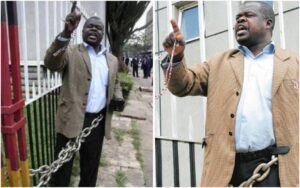
Okiya Omtatah when he chained himself to the gate of the Kenya police headquarters in 2008 to protest allegations that police shot protesters in demonstrations over the disputed 2007 presidential polls. UGC.
The word privatisation is not used here to refer to state divestiture (a key plank of the 1990s/2000s International Monetary Fund (IMF) and World Bank (WB) inspired structural adjustment); rather it refers to the total capture of the state and its institutions to serve purely private interests. Such capture borders on criminality and is, indeed, a precursor and camouflage for criminal activities.
In anti-corruption theorising, we talk about three levels of corruption: petty corruption, grand corruption and looting. Criminalisation of the state paves the way for looting,which in turn impacts on both micro and macro fundamentals of the economy.
The Goldenberg corruption scandal in the early 1990s, is one of Kenya’s best examples of looting. For those who are unaware of the facts, after the scandal, the price of bread (for example) increased, in one fortnight, from 5 Kenya shillings to 15 Kenya shillings!
The sharp increases in prices of consumer goods fundamentally reduced spending power, deepening both poverty and misery. Inflation went up to unprecedented levels, negatively affecting both small and big businesses.
The fake fertiliser saga is now the main manifestation of the state criminality. After weeks of denial, the state has now launched investigations into the saga. The Senate has also started its own investigations.
A committee of the Senate started its probe by listening to a documentary by distinguished journalist and documentary producer, John-Allan Namu, and his firm, Africa Uncensored, titled “Fertile Deception”. The documentary has since gone viral as younger Kenyans grapple with the new reality of a criminal state.
If the administration of Uhuru-Ruto laid the basis for rejection of Kenya’s transformative constitutional dispensation, the Ruto-Gachagua administration has taken the state back to the real dark days by reinventing state criminality and criminalising the rights and freedoms of citizens.
Silencing citizens in this case is not an end in itself; rather it is a means to an end – to make sure there is little opposition to the continued criminalisation of the state. It also reinvents the culture of fear that characterised the Kenyatta and Moi dictatorships.
This, to me, is the context within which the tribulations of Omtatah find proper explanation. The assumption by the powers that be, that the system would “capture” this mercurial Senator and social rights activist from Busia have not borne fruit.
Omtatah has even publicly disagreed with the president, insisting that the Constitution of Kenya is sacrosanct. Remember that in order for the criminalisation enterprise to succeed, the implementation of the Constitution has to be completely jettisoned.
Omtatah’s crime is to be a beacon of opposition to this criminal enterprise.