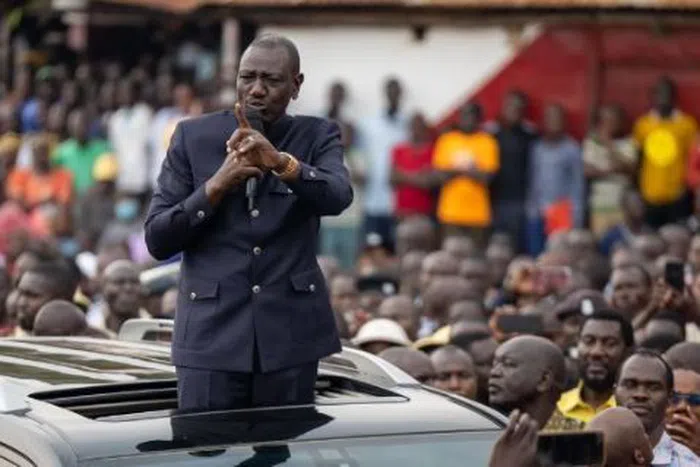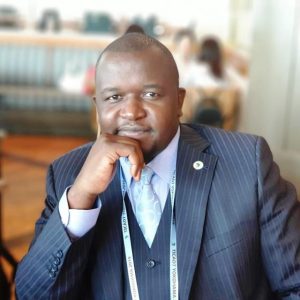


NJ Ayuk speaking during the Oxford Business Africa Forum. PHOTO/UGC
By PATRICK MAYOYO
With over 600 million people without access to energy in Africa, it only makes sense that the continent harnesses all of its natural resources to alleviate energy poverty, African Energy Chamber (AEC), Executive Chairman, NJ Ayuk, has said.
Mr Ayuk said the path that will get African countries to net zero emissions should not, cannot and must not be the same path that European countries travel.
“Natural gas, affordable and abundant in Africa, has the power to spark significant job creation and capacity-building opportunities, economic diversification and growth. Why shouldn’t Africa capitalize on those opportunities?” he asked.
Mr Ayuk was speaking during the Oxford Business Africa Forum following the release of his third bestselling publication, A Just Transition: Making Energy Poverty History with an Energy Mix, under the theme, Africa’s Case for Energy and a Just Energy Transition.
In his address, Mr Ayuk made clear the need for a pragmatic approach to the energy transition, in which the path that will get African countries to net zero emissions should not, be the same path that European countries travel.
As noted in his book, Mr Ayuk recognized that the climate crisis represents a major challenge worldwide. In fact, Africa faces the worst impacts of the crisis, with environmental disasters threatening the livelihoods of millions of people. He however, noted that immediately transitioning away from oil and gas will not bring the economic relief the continent needs.
“I am not saying that African nations should continue oil and gas operations indefinitely, with no movement towards renewable energy sources. I am saying that we should be setting the timetable for our own transition, and we should be deciding how it’s carried out,” he explained.
Support partnerships and open communications
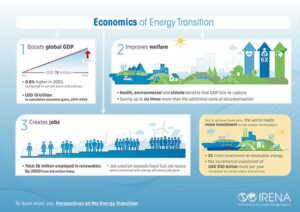
Economics of Energy Transition. GRAPHIC/IRENA
Mr Ayuk said instead of Western pressure to bring African oil and gas activities to an abrupt halt, he would like to see a cooperative effort, partnerships, relationships rooted in respect, open communications and empathy.
“What does that look like? It begins with the belief that when African leaders, businesses and organizations say the timing is not right to end our fossil fuel operations, that we have a point. That when we are discussing our own countries, we know what we are talking about,” he noted.
Throughout his presentation, Mr Ayuk provided in-depth insight into energy poverty in Africa, detailing how lack of energy triggers challenges regarding cooking, air pollution, health, education, employment and many more. He however, added Africa has the solution to addressing energy poverty through the exploitation of its natural gas.
“A comprehensive approach to battling energy poverty, one that includes gas-to-power initiatives, is absolutely necessary. And we are seeing movement in that direction. More than a dozen African countries are already using natural gas they produce themselves or import from other countries to generate electricity,” he said.
The African Energy Chamber boss added that new projects are on the way and Ghana, for example, is preparing to launch sub-Saharan Africa’s first LNG-to-power plant before the end of the year. Cameroon plans to convert an oil-fired power plant at Limbé to a natural gas-fired facility and expand production capacity. In Ivory Coast, a new combined cycle power plant is coming to Jaqueville.
“These projects will change African lives for the better. Reversing direction now would be a serious mistake,” he warned.
In addition to energy poverty, Mr Ayuk went on to describe the economic benefits associated with oil and gas utilization in Africa. Noting, while renewable energy resources have and will continue to play a role in electrifying the continent – particularly across remote areas of the continent where grid connection is not feasible – oil and gas is the only way to kick start industrialization.
Alternative solution
In this scenario, Mr Ayuk proposes an alternative solution to the trend evident in investing in Africa. Rather than continue with financial aid, he emphasizes that investment and partnerships represent the only way of addressing energy poverty and driving economic progress.

Canada’s roadmap to 100 percent renewable energy by 2050. GRAPHIC/CLEANTECHNICA
“We don’t need help or quick fixes. We don’t need aid. We need partners and investors. We need free-market solutions that contribute to long-term stability and economic growth,” he emphasised.
Mr Ayuk said with Africa strategically harnessing oil and gas resources, economic growth and objectives are within reach.
“The idea is to use our natural gas as a feedstock to create other value-added products, like petrochemicals, from fertilizers to ammonia. Then we take the revenues to build infrastructure, from pipelines to ports and roadways. And we open the door to economic diversification,” he added.
Mr Ayuk made a strong case for an African-focused approach to the energy transition, citing energy poverty, economic development and investment as primary concerns. He said by establishing its own path to transitioning, Africa will be well equipped to make energy poverty history, mitigate climate change while at the same time driving long-term and sustainable socioeconomic growth.
“Why not, instead, take a strategic approach to Africa’s energy transition? Why not set aside a portion of fossil fuel revenues to help fund the infrastructure we need? Why not continue investing in African oil and gas projects, natural gas projects in particular, to move Africa closer to achieving a successful energy transition?,” he asked.
Mr Ayuk said there was need for developed countries to share clean energy technologies with Africa, so as African countries can employ solutions like carbon capture, to keep carbon emissions to a minimum.
“Africa needs an energy transition that takes a pragmatic approach to resolving energy poverty: by making our natural gas resources part of the solution,” he concluded.