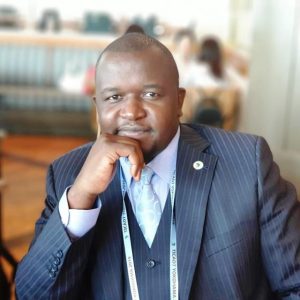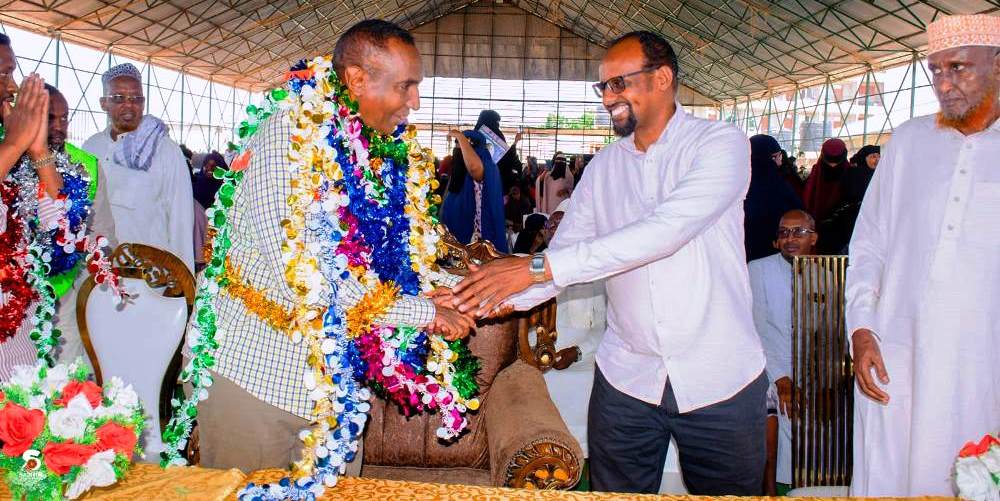


Former Foreign Affairs Cabinet Minister Chirau Ali Mwakwere after being installed as Mijikenda spokesman. PHOTO/UGC.
By PATRICK MAYOYO
The recent elevation of Chirau Ali Mwakwere to the position of spokesperson for the Mijikenda community represents a seismic shift in the political dynamics of Coast region, as the country heads toward the 2027 general elections.
This development signals a new phase in the community’s long-standing struggle for emancipation particularly within a region historically dominated by powerful ethnic and economic elites.
The installation of Mwakwere, a former Cabinet Minister and Matuga Member of Parliament (MP), as the spokesperson and political kingpin for the Mijikenda community that comprises the Duruma, Digo, Giriama, Rabai, Chonyi, Kauma, Kambe, Jibana, and Ribe sub-tribes, is a significant moment in the ongoing political evolution in coast region.
Mwakwere’s installation ceremony was attended by former Cabinet Ministers Noah Katana Ngala, the son of the late Coast political kingpin Ronald Ngala, Morris Dzoro, who served in Kibaki’s government, former KNUT national chairman Mudzo Nzili among other Coast luminaries.
The Mijikenda community has faced a number of challenges for decades, primarily revolving around issues of land ownership with most coastals living as squatters on their ancestral land.
Historically, the region’s coastal lands were alienated during the colonial era, with large tracts being handed over to foreign settlers, including Arab and Asian tycoons.
This alienation left the Mijikenda and other indigenous communities relegated to a marginalised status, particularly when it came to land ownership. Many of the Mijikenda now live as squatters on their ancestral lands, while absentee landlords, often from Arab and Asian backgrounds, continue to own large parcels of land.
These historical grievances have compounded the community’s economic struggles and contributed to a pervasive sense of political and social marginalisation.
Despite being a significant demographic in the region, the Mijikenda have often found themselves sidelined in the face of powerful political elites who control the economic and political structures of the Coast region.
This exclusion has been particularly evident in the case of political leadership, where elected leaders are mainly funded by Asian and Arab tycoons most of them agents of the absentee landlords.
Mwakwere’s appointment as the spokesperson for the entire Mijikenda community is an effort to unite the historically fragmented sub-tribes under a single political banner.
Having previously served as the spokesperson for the Digo community, Mwakwere now assumes a broader role in articulating the concerns of all nine Mijikenda sub-tribes.
His role is not only to be a spokesperson but also to act as a political “kingpin” who can guide the Mijikenda community towards achieving greater political agency and representation.
Mwakwere’s leadership is especially significant because it comes at a time of increasing dissatisfaction within the Mijikenda over the region’s political trajectory.
The alignment of several prominent Coast leaders, such as Mining CS Hassan Joho, Sports CS Salim Mvurya, and Mombasa Governor Abdulswamad Shariff, with President William Ruto’s re-election campaign has drawn sharp criticism from a cross-section of Coast leaders including the Mijikenda community.
These leaders are accused of betraying the Coast people by aligning with Kenya Kwanza without consultations with other stakeholders or negotiating for lasting solutions to the Coast people problems in the view of many in the Mijikenda community, has not addressed their long-standing grievances.
Mwakwere’s position is also reinforced by the support of the Mijikenda Council of Elders, whose decision to elevate him serves as a symbolic break from the political status quo, in which power has been largely concentrated in the hands of a few influential families and individuals.
This marks a key turning point, as the Mijikenda seek to chart their own political future, independent of the established power structures that have historically marginalised them.
The Mijikenda community’s growing political mobilisation is tied closely to their planned alignment with the United Opposition, led by Wiper Party leader Kalonzo Musyoka. This shift is viewed as a major political re-alignment in Coast region as the country heads towards the 2027 polls.
The Mijikenda have since the advent of multi-partism in the country aligned their politics with the opposition with the hope of their historical injustices on land ownership being addressed.

Former Cabinet Minister Noah Katana Ngala at the installation ceremony that took place at the home of his late father Ronald Ngala. PHOTO/UGC.
It is against this background that they rallied behind the Mwai Kibaki led Narc coalition and after the death of Karissa Maitha, who was instrumental in mobilising the region, they shifted their allegiance to the then Raila Odinga led ODM that currently still has the majority of elected leaders in the region.
But following Raila’s death and divided opinion on whether the party should support President Ruto in 2027 or not the development has raised a political storm in the Coast region.
Assertions by Coast leaders like Mines CS Joho, Sports CS Mvurya and Mombasa Governor that they will support President Ruto’s re-election in 2027 has reignited rebellion in the region.
A section of Mijikenda leaders have questioned this decision saying no consultations or public participation was conducted before such a decision was made.
The community’s hope is that by allying with the opposition coalition, they can secure both greater political representation and solutions to the pressing issues of land ownership and the squatter problem.
The opposition’s platform offers the Mijikenda a compelling alternative to the ruling coalition, whose leaders they say have largely ignored or downplayed the region’s unique challenges.
They believe Kalonzo, a seasoned politician with a long track record in Kenyan politics, represents a stable figure under whose leadership the Mijikenda can not only gain political influence but also ensure that their specific needs are met.
It has to be noted that Mwakwere a former Matuga MP, contested for the Kwale gubernatorial race in 2022 on a Wiper ticket that was won by UDA’s Fatuma Achani.
Furthermore, the Mijikenda community’s push for a Mijikenda candidate to contest for the Mombasa gubernatorial seat is emblematic of their desire to reclaim political control in the Coast region’s capital city.
A Mijikenda-led Mombasa County government they believe would be better positioned to address the economic injustices faced by the community, especially concerning the issue of absentee landlords and land ownership.
The death of Karissa Maitha, a prominent Mijikenda leader, left a significant void in the region’s leadership. Maitha, a former Minister for Local Government in the Kibaki administration, was seen as a staunch advocate for Mijikenda rights and a key figure in addressing historical land injustices.
His passing, coupled with the declining political influence of other Mijikenda leaders, has contributed to a leadership vacuum that the community is now striving to fill.
In the absence of a clear political leader, the Mijikenda community has turned to their traditional leadership structure, the Mijikenda Council of Elders, to identify a unifying figure.
Mwakwere’s appointment is thus not only a response to the community’s immediate political needs but also a long-term strategy to ensure that the Mijikenda have a coherent and effective voice in national politics.
Another critical factor in the Mijikenda’s political mobilisation is the increasing dominance of wealthy Arab and Asian tycoons in the region’s economy and politics.
These tycoons control key sectors such as real estate, shipping, and tourism, and have historically played a pivotal role in financing political campaigns.
This economic power has allowed them to exert disproportionate political influence, often at the expense of the indigenous Mijikenda population.
As they say whoever pays the piper calls the tune, this transactional leadership has resulted in Mijikenda elected leaders doing what their paymasters say and not what their electorate want.
A break from this type of politics would be in the best interest of the Mijikenda and Coast voters as a whole. You cannot expect to address the squatter and absentee landlords problems in Mombasa and Coast region in general if agents of the absentee landlords continue funding campaigns of Coast elected leaders.
The Mijikenda community views the growing dominance of these wealthy elites as one of the key reasons for their continued marginalisation.
The region’s economic and political power dynamics have been tilted in favour of a few affluent groups, and the Mijikenda hope that by asserting their political power, they can redress these imbalances.
As the 2027 general election approaches, the Mijikenda community is positioning itself to play a central role in the Coast region’s political future.
Through their alliance with the opposition, the Mijikenda hope to secure political representation that reflects their interests, particularly on issues related to land ownership and historical injustices.