

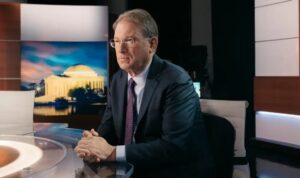
The Atlantic editor-in-chief Jeffrey Goldberg (Left) talks to then U.S. Secretary of State John Kerry (Right) during The Brooking Institution’s 2016 Saban Forum at the Willard Hotel in Washington, D.C. on December 4, 2016.PHOTO/Wikimedia Commons.
By PATRICK MAYOYO
It was a moment that read like the plot of a political thriller, but for Jeffrey Goldberg, it was all too real.
The esteemed editor-in-chief of The Atlantic found himself inadvertently added to a private Signal chat, where senior officials in Donald Trump’s administration were discussing highly sensitive military plans.
What followed was an extraordinary journalistic scoop, a fierce political backlash, and a glimpse into the inner workings of the highest echelons of US national security.
Goldberg, 59, has long been one of America’s foremost journalists covering national security. Born in Brooklyn, he studied at the University of Pennsylvania before leaving to serve in the Israel Defense Forces.
His time as a prison guard during the First Intifada formed the basis of his 2006 book, Prisoners: A Muslim and a Jew Across the Middle East Divide.
His journalistic career took him from The Jerusalem Post to The Washington Post, and later The New Yorker, where he spent five years as Middle East correspondent.
In 2007, he was recruited to The Atlantic under rather unusual circumstances—its owner at the time, David Bradley, sent ponies to Goldberg’s Washington home as a gift for his three children. Nine years later, Goldberg took the helm as editor-in-chief.
Under his leadership, The Atlantic has flourished, winning multiple Pulitzer Prizes and National Magazine Awards. It has also expanded its political coverage and recently recruited top journalists from The Washington Post.
But even with his extensive experience in political journalism, nothing could have prepared Goldberg for what happened earlier this month. One moment, he was going about his usual work; the next, his phone lit up with an invitation to a Signal chat. The sender? US National Security Advisor Michael Waltz.
Initially, Goldberg thought it must be a hoax. But before he knew it, he was inside a chatroom where some of the most powerful figures in the Trump administration—including Secretary of State Marco Rubio, Secretary of Defence Pete Hegseth, CIA Director John Ratcliffe, and Director of National Intelligence Tulsi Gabbard—were actively discussing military operations in Yemen.
“They didn’t seem to notice I was there,” he later recounted in an interview with the BBC.
Once the gravity of the situation dawned on him, Goldberg did what any journalist would: he reported the story. His article for The Atlantic outlined how senior officials had mistakenly included him in the discussion of an upcoming military strike. But what began as a shocking revelation quickly turned into a political firestorm.
President Trump branded Jeffrey Goldberg a “loser” and a “sleazebag.” PHOTO/UGC.
President Trump branded Goldberg a “loser” and a “sleazebag”, while Waltz dismissed him as “scum” and a liar. The White House sought to downplay the blunder, claiming that no classified information had been shared.
Yet, when officials doubled down, insisting the details weren’t sensitive, The Atlantic responded by publishing the full text of the messages. These messages revealed precise operational details—times, locations, and weaponry—about a planned attack on Houthi rebels in Yemen.
Goldberg has remained unfazed by the personal attacks. “This is their move,” he said. “You never defend, just attack.”
But beyond the political spectacle, serious questions remain. How was a journalist’s number in Waltz’s contacts in the first place? Why were top national security officials discussing sensitive operations on an app like Signal?
And why, Goldberg asks, is there a different standard of accountability for high-ranking officials than for lower-ranking military personnel?
“If you were an Air Force captain working with the CIA or the State Department and you mishandled information this way, you’d be fired and prosecuted,” he pointed out.
Some were surprised that Goldberg ultimately left the chat of his own accord. Wouldn’t any journalist want to stay and see what happened next? But for Goldberg, there were ethical and legal considerations at play.
“There’s a part of me that would love to see what else is happening in there,” he admitted. “But there are all kinds of issues related to law and ethics that I can’t go into. Believe me when I say that I made that decision with good advice.”
The incident has now sparked demands for an investigation in Washington, with both Democratic and Republican lawmakers calling for answers.
As for Goldberg, he has emerged from this unlikely ordeal with his reputation intact, another scoop under his belt, and an even more prominent place in the ongoing battle between journalism and political power.
If there’s one lesson to be learned from this extraordinary episode, it’s that in the world of politics and the press, truth is often stranger than fiction.