

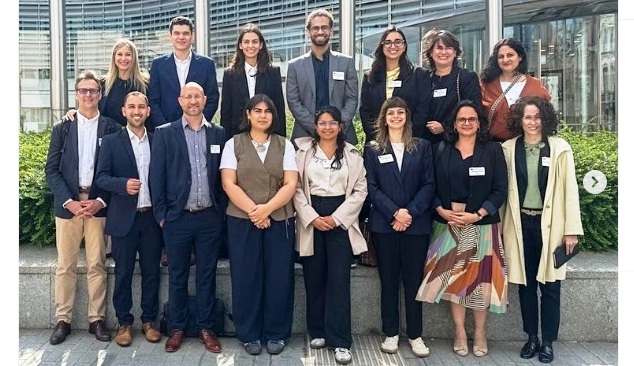
Baha’i International Community’s Brussels Office welcomes colleagues from national offices in France, Germany, the Netherlands, Italy, Luxembourg, Spain, and the United Kingdom. PHOTO/BIC.
By SPECIAL CORRESPONDENT
The Iranian authorities are intensifying a campaign of scapegoating and incitement against the Baha’i community amid a deepening national crisis, the Baha’i International Community (BIC) has warned, accusing the state of spreading disinformation, broadcasting forced confessions and escalating arrests.
In a statement issued as protests continue across Iran and reports of violence and loss of life mount, the BIC said it was “alarmed” by what it described as a familiar pattern: the targeting of Baha’is during periods of social, political or economic upheaval since the 1979 Islamic Revolution.
According to the BIC, Iranian state media has in recent days broadcast programmes containing false allegations against Baha’is, including what it says were clearly coerced confessions.
Over the past week, Channel 2 of state television is reported to have aired content accusing members of the community of involvement in unrest, while arrests and detentions of Baha’is have increased across the country.
On 1 February, Islamic Republic of Iran Broadcasting (IRIB), the country’s main state media organisation, aired what it described as “confessions” by two Baha’is linked to the protests.
Human rights organisations have long documented the use of forced confessions in Iranian prisons, where detainees are allegedly subjected to threats, pressure and torture. The public broadcast of such confessions is being described by the BIC as a significant escalation in the persecution of the Baha’i minority.
For decades, Iran’s authorities have sought to justify restrictions on and repression of the Baha’i community through allegations of disloyalty and subversion. The BIC says no evidence has ever been produced to support these claims, and that their credibility has steadily eroded both inside Iran and internationally.

Bahá’í International Community Principal Representative Bani Dugal and Representative to the #UN Liliane Nkunzimana attending a United Nations General Assembly High-Level Meeting. PHOTO/UGC.
“This is another attempt by the Iranian government to falsify the truth and present falsehoods to its own public,” said Simin Fahandej, the BIC’s representative to the United Nations in Geneva. “During every period of national crisis, whether social, economic, or political, the authorities have consistently and systematically scapegoated the Baha’is. We are seeing that pattern once again.”
Ms Fahandej stressed that the Baha’i community has repeatedly rejected violence, even while facing sustained persecution.
“Despite the false accusations and cruel treatment they have endured, the Baha’is in Iran have acted with resilience and service to their country and have never responded with violence,” she said. “Their commitment to truthfulness and to the well-being of their nation has remained steadfast.”
Speaking during a recent special session on Iran at the UN Human Rights Council in Geneva, the BIC also highlighted that the injustices long experienced by Baha’is are now affecting many other Iranians. The organisation expressed sympathy for families who have lost loved ones amid the ongoing unrest.
“All Iranians, from every religion, ethnicity and background, deserve to play a decisive role in shaping their country,” Ms Fahandej said. “This is an inherent human right that no government can take away.”
The BIC has called on the international community to unequivocally condemn the scapegoating and persecution of the Baha’i community and to press for justice and accountability for all people in Iran, warning that silence risks enabling further abuses at a moment of profound national crisis.