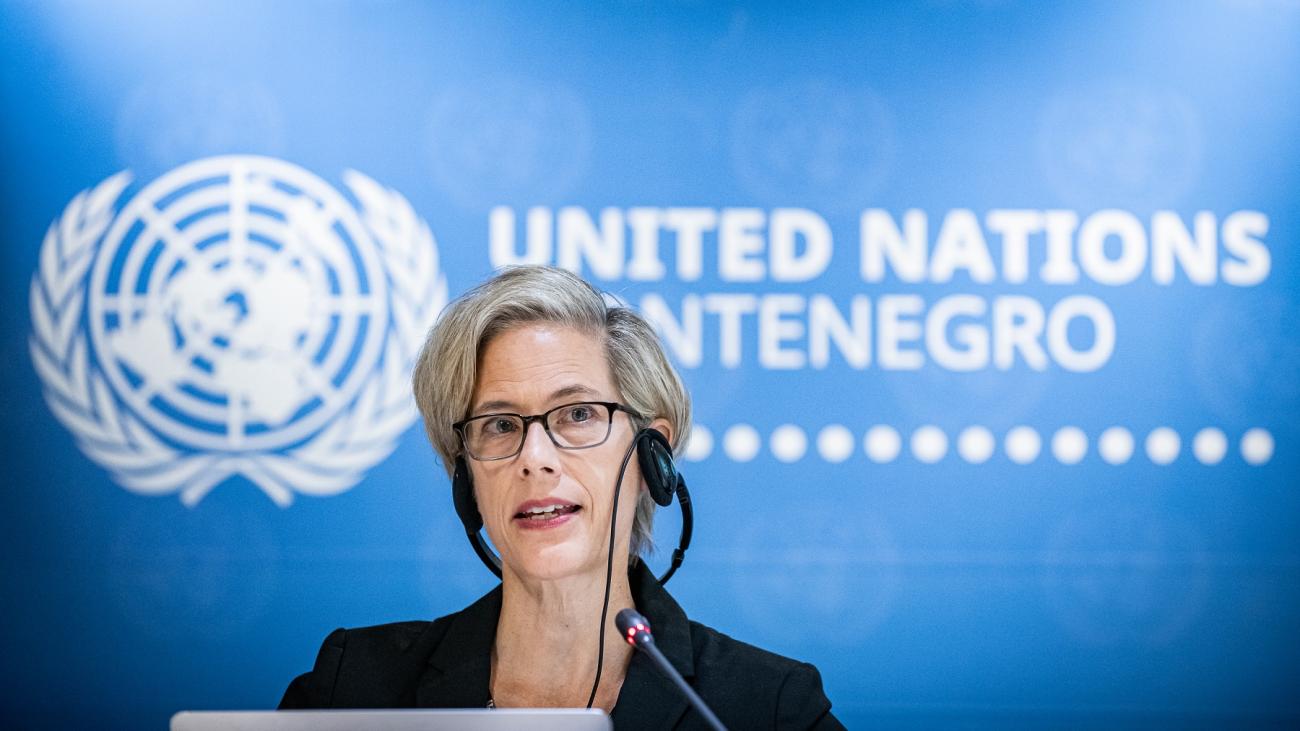


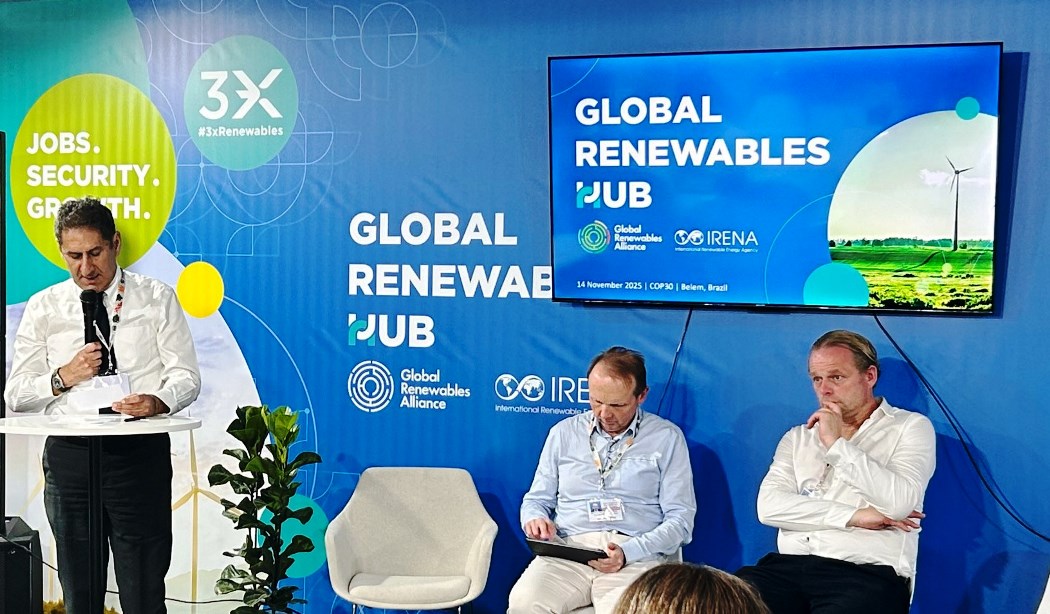
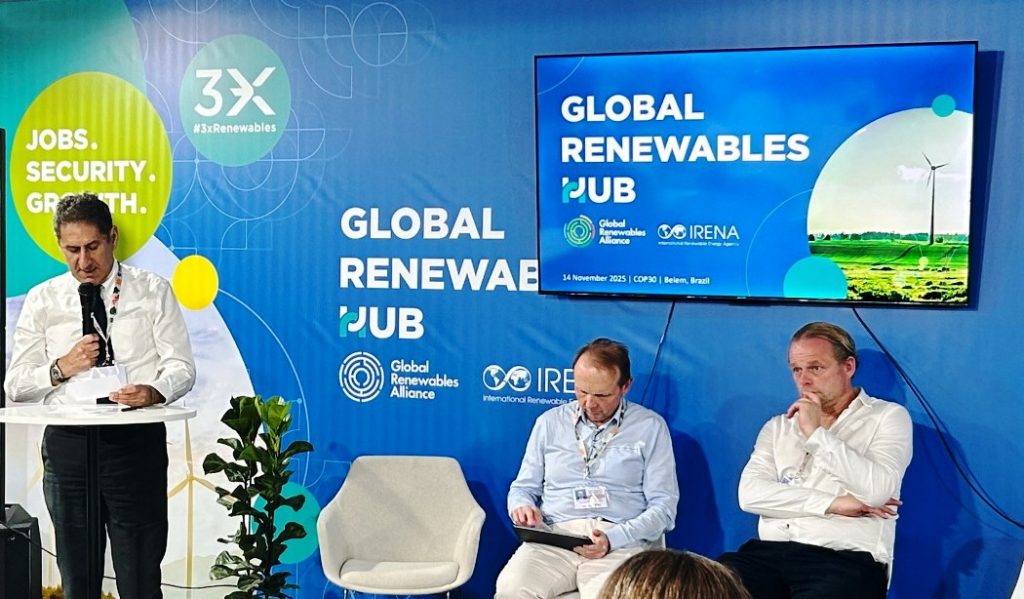
IRENA at COP30. PHOTO/IRENA.
By PATRICK MAYOYO
One of the five things that the 30Th United Nations Climate Change Conference (COP30) in Belém, Brazil, underscored was the urgent need for action to accelerate the global transition to clean energy in the global fight against climate change.
With the planet’s future hanging in the balance, leaders, activists, and industry giants gathered to discuss the path forward for renewable energy, energy efficiency, and sustainable development. As the world grapples with the mounting climate crisis, five crucial themes emerged from the discussions.
The International Renewable Energy Agency (IRENA) delivered a cautiously optimistic message: the goal of tripling renewable energy capacity and doubling energy efficiency by 2030 remains achievable. The global energy landscape is seeing record levels of renewable energy deployment, with 2024 set to break records for the third consecutive year.
Still, the road ahead is fraught with challenges. Investment bottlenecks, outdated grid infrastructure, and a lack of skilled workers threaten to slow the momentum needed to meet these ambitious targets.
Ahead of the COP30 in Belém, IRENA identified five priority areas to accelerate progress towards efforts to triple renewables globally and double energy efficiency by 2030 – both critical energy targets to keep the Paris Agreement goals alive.
IRENA’s custodian report Delivering on the UAE Consensus: Tracking progress toward tripling renewable energy capacity and doubling energy efficiency by 2030 confirmed the target of 11.2 TW of installed renewable power capacity by 2030 remains within reach, thanks to record-breaking renewables additions for a third consecutive year in 2024.
IRENA’s pavilion, the Global Renewables Hub jointly hosted with the Global Renewables Alliance (GRA), provided a lively platform for engaging exchanges with IRENA Members, partners and guests.
Released to inform the global finance discourse, Global Landscape of Energy Transition Finance 2025 revealed a new record of USD 2.4 trillion in energy transition investments in 2024, but these were highly concentrated in advanced economies, leaving emerging and developing countries behind.
In a bilateral meeting with UN Secretary-General António Guterres, IRENA Director-General Francesco La Camera briefed him on progress towards the UAE Consensus goals to triple renewable capacity and double energy efficiency by 2030, and reaffirmed the Agency’s commitment to strengthening regional cooperation and boosting energy transition finance.
Launched at COP30, IRENA’s new Regional Energy Transition Outlook South America highlights the vast opportunities for economic growth, innovation, and energy security across the region through cooperation and the scale of investment. The region could significantly grow its GDP while creating more than 12 million jobs in the energy sector by 2050.

Global utilities set out US$ 1 trillion investment plans at COP30.PHOTO/UNEZA.
As a group of the world’s leading power utilities, the Utilities for Net Zero Alliance (UNEZA), facilitated by IRENA, aims to address key investment barriers, particularly in grids and flexibility. At COP30, UNEZA announced increased investment commitments of nearly USD 150 billion annually, with a major focus on grid infrastructure.
However, it also flagged bottlenecks in investment, grids, supply chains and skills, urging for bolder national renewable targets before COP30. And it pinpointed to geographical imbalances in renewable deployment, continuously threatening a just and inclusive transition.
At COP30, implementation was front and centre, with a strong focus on how to advance existing commitments. Parties reaffirmed the central role of Nationally Determined Contributions (NDCs) in guiding the transition.
The trends in energy sector commitments in NDC 3.0s reflect a growing alignment with the UAE Consensus goals, which countries are increasingly integrating into national plans, emphasising renewable deployment and low-carbon technologies.
Published at COP30, IRENA’s new report on Climate action support 2025 shows how IRENA actively engages with its Members to assist in the development of climate commitments. To date, the Agency provided support to 102 countries through 240 activities since 2020, representing a combined population of 6 billion people globally.
With the aim to translate commitments into action, COP30 witnessed a strong push of the Climate Action Agenda, inspired to foster engagement by businesses, investors, and civil society through scaling the many initiatives already in motion.
In Belém, particularly the importance of building enabling infrastructure for the energy transition gained further prominence, with discussions underscoring the need for expanded, modernised and flexible grids to accommodate and encourage higher shares of renewable power generation.
According to IRENA, substantial additional investment will be required, with USD 791–912 billion per year needed for grids and flexibility to 2030, including around USD 670 billion annually to strengthen electricity grids so that new cost-effective renewable capacity can be effectively used while maintaining secure and reliable system operation.
The Utilities for Net Zero Alliance (UNEZA) advanced this agenda by collectively committing to invest USD 1 trillion to 2030 in grids, storage and new transmission corridors. While the commitments are not yet in line with the level necessary, they showcase a concrete commitment by utilities to move this forward.
Global renewable energy investment hit US$ 807 billion in 2024. PHOTO/IRENA.
Discussions at COP30 repeatedly highlighted the persistent misalignment between the pace of renewable deployment and the scale of finance available, particularly in emerging markets and developing economies where investment flows remain well below the levels required for a 1.5 °C-consistent pathway.
IRENA’s new Global Landscape of Energy Transition Finance 2025 report confirms that global investments in the energy transition reached a new record of USD 2.4 trillion in 2024.
But despite this milestone, year-on-year growth of renewables slowed significantly, with annual investments increasing by 7.3% in 2024, compared to 32% the year before. Furthermore, 90% remained concentrated in advanced economies and China, leaving emerging and developing countries behind.
Renewable-energy supply chains, spanning manufacturing, critical minerals, components and logistics, are increasingly recognised as central to the success of the global energy transition. Persistent vulnerabilities and concentration risks need to be addressed to support a secure and sustainable scale up of renewables.
At COP30, supply chains featured more prominently in ministerial discussions and in the Climate Action Agenda. For example, UNEZA and the Global Clean Power Alliance (GCPA) announced a new strategic partnership to address supply chain challenges affecting the power sector globally.
Strengthening supply-chain resilience remains an important area for continued international co-operation, particularly as countries seek to reconcile energy security, affordability and sustainability objectives.
The COP30 outcome reaffirms equity, intergenerational fairness and international cooperation as core principles and calls on countries, subnational authorities, civil society and the private sector to accelerate action.
These references are consistent with IRENA’s recognition that workforce development, skills, social protection and inclusive policy frameworks are key enablers of a just and equitable energy transition that leaves no one behind.
IRENA’s ongoing work on skills and socio-economic impacts provides an important foundation that can be further used to support countries in aligning social outcomes with the broader objectives of the energy transition.
Join IRENA’s call to action on skilling here.